
Emptiness and Gasoline
Short story written on one dark Upstate New York night

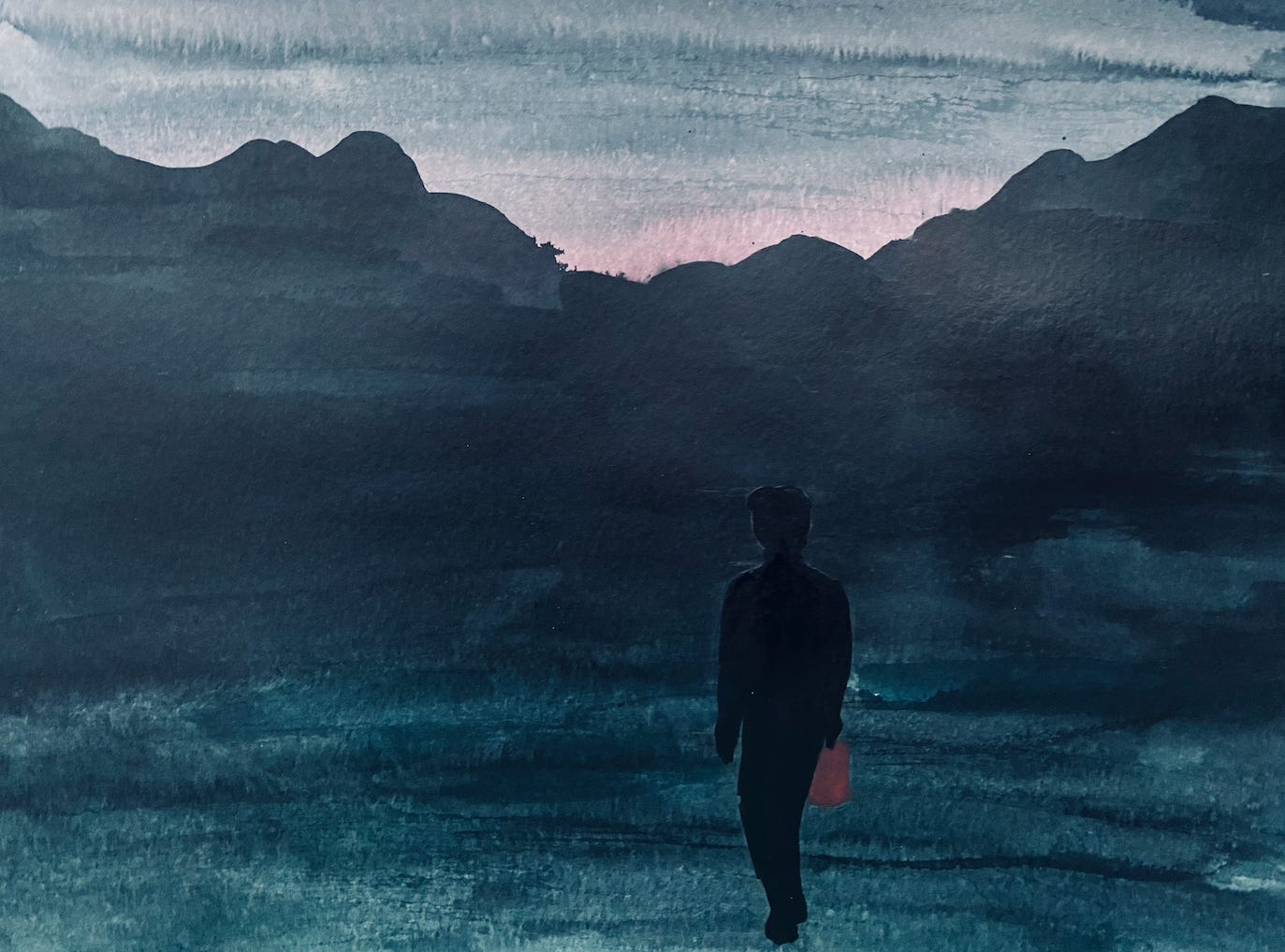
The engine died on the top of the hill. The driver looked at the dashboard and saw that the gas was at zero. He didn’t swear, didn’t sigh, only smiled sadly. It wasn’t characteristic of him to forget about the fuel level, but there are life circumstances that make even the most organized of us scattered. With a sad smile seemingly frozen on his face, he rummaged his pants for a wallet and went to search for gas. When he turned off the headlights hanging on the power of an old battery, he got submerged into the thick humid darkness of the cloudy subtropical night. His phone was dead, so the was no other source of light, no source of direction either. There was a memory of a station a couple of miles down the windy mountain road he was driving on.
It was a forest road: completely dark, enveloped in the sweet and ashy smell of the invisible in the night vegetation. It was muffled by the songs of cicadas, crickets, frogs, and everyone else who deemed the night their time and the forest their kingdom. A lonely man dressed in black jeans and a black jacket was a foreigner there, but he also was quiet and invisible in the surrounding darkness. He merged with it, walking lightly and gently on the road.
He walked like that for half an hour, in complete darkness, a silent shadow of the night, a ghost. Labor of the walk removed sadness from his face and left only a slight smile, only steps made, only miles of sheltering darkness. He accelerated his pace, almost ran, invisible, invincible. At a low point, slightly panting, he raised his head up and looked at the crowns of the pitch-black trees merging over the road in the background of only slightly lighter sky. He breathed out loudly into them and smiled with maybe even firmness.
A sleepy teen at the gas station sold him gas and a canister. She yawned and went back to the peaceful, dreamy existence before he exited the store. The gas station was on the outskirts of a small town, which was completely asleep at the time the driver was getting his gas. Still alone and only slightly betrayed by the light of dim rural lights, he started his way back. There was now the heaviness of the full canister of gas in his hand, and there was the heaviness of the upcoming walk uphill. Those two got transferred into the heaviness of his step, heaviness of his face, heaviness of his thoughts, heaviness of the realization that the short magical trip was about to be over, and it was time to go back to where he had been going.
Where he was going used to be a good place. It used to be “our” place. It was warm, comfortable; in it there was our couch, our table, our bed and so many other ours. He used to rush to that place from all his trips, used to drive ignoring hunger and sleep, putting mile after mile in the effort to get there. Then something had broken in the language (it must have been the language), and “our” place had become “my” place. That one didn’t worth the effort. He heavily dropped the gasoline on the ground and looked around, hoping to catch a ride up the hill. There was big humid dark nothingness around him, then somewhere in the backyards he saw a neon light saying “Crossroads. The travelers’ bar.” Without thinking for even a second, he marched towards this refuge, saving him from the necessity of his trip.
The bar was empty and dark. Only the wall with numerous alcoholic drinks was lightened by a soft light. He came closer to the bar stand and saw a call button on it. He chuckled at the laziness of the barkeep, sat on a stool, placed the canister on another, and pressed the button. There was a muted sound of a bell chiming somewhere in the belly of the building. A minute or two after that, a woman entered the room through an invisible in the darkness door.
She was beautiful, by all standards beautiful in the man’s opinion. She walked into the light and smiled radiantly at him, leaning on the counter. This movement pushed her dark brown hair from behind her ears. They spilled over her shoulders like a full river spills over the banks. They surrounded her beautiful face and halted in calm, still darkness. Nothing moved in the man’s face in reaction to her appearance or even to the flood of her hair. Nothing moved in his body. Maybe only the heaviness, the weariness slouched his shoulders a little more.
“What are you feeling like?” asked the bartender, waving her head slightly towards the drinks. She watched how crossed his face a jerk of a twisted by pain smile of someone who just have realized that they cannot afford to keep with social games anymore. She was an experienced bartender, she knew the meaning. She knew the truth would follow. “Something that will make me forget everything,” the man said, covering the failure of composure with a radiant friendly smile. He was handsome when he smiled, he was told. “I’ve got that,” said the bartender and in a habitual move pulled from the stand behind her a bottle with a silver label and letters on a language unknown to the man. She poured it into a glass, and he, reassured by her unphased reaction to his sudden failure of composure, drank it in one go.
The drink burned like strong drinks do. It burned his lips, his mouth, his throat, propagated its warmth down his belly, but unlike strong drinks, it didn’t stop there. The liberating warmth was making its way through his body, forming a quaint network of strange sensations in it. He looked quizzically at the woman. She smiled, satisfied with his reaction. “It’s pure emptiness,” she said. The man laughed loudly, threw his head back, and then pushed his glass to her: “One more!” “One shot of emptiness is plenty,” she smiled and put away the bottle with the silver label back to the alcohol stand. He didn’t expect such a reaction; that’s not what bartenders do after all. He looked into her face searching for an explanation for her behavior. “It is,” she replied to his curiosity. “It just takes time. But eventually it’ll erase what hurts, don’t worry.” He chuckled softly and pulled out his wallet. “Too much drinking isn’t good for driving anyway,” he replied.
When he put his credit card in front of her, she waved her hand in rejection. “Just give some of what you brought,” she said. “This?” he raised the heavy gas canister to the counter. She unscrewed it, put an empty unlabeled bottle next to it, and started carefully pouring gasoline into the bottle through the small metal funnel. “A fuel carried by a heartbroken person who dreads his journey — is one of the finest and rarest drinks in the Universe,” she explained after she was done. “Just don’t try to drink it today. Emptiness and gasoline don’t mix well: things that want to burn need to burn, you see. Things that don’t exist, that aren’t, cannot provide material for that. Bad combo. The gasoline keeps roaming in the emptiness, searching for fuel, never finding it. And that roaming inside makes eventually one roam too, roam until you forget your way home. Wandering across all the worlds, never finding your way back, never finding peace either. Not something to be taken lightly.”
No one ever does as they are told. After filling the gas tank, the man, maybe out of curiosity, maybe out of rebellion, touched the gas canister with his lips. The liquid didn’t taste or smell like it was supposed to. Instead, it smelled of his now-empty apartment, of his couch. “The emptiness didn’t work,” he sighed into the dark sky. He still remembered how his home looked before the language broke. He couldn’t imagine returning to it in its after state. He kept imagining that somewhere there, despite the series of thorough cleanings, he’d find a hidden long red hair. Nausea crawled upon him from this image. He didn’t know what he would have to do then. He took a big sip from the canister.